
Chapter 1: Ant Reef – Arrival and Stripping
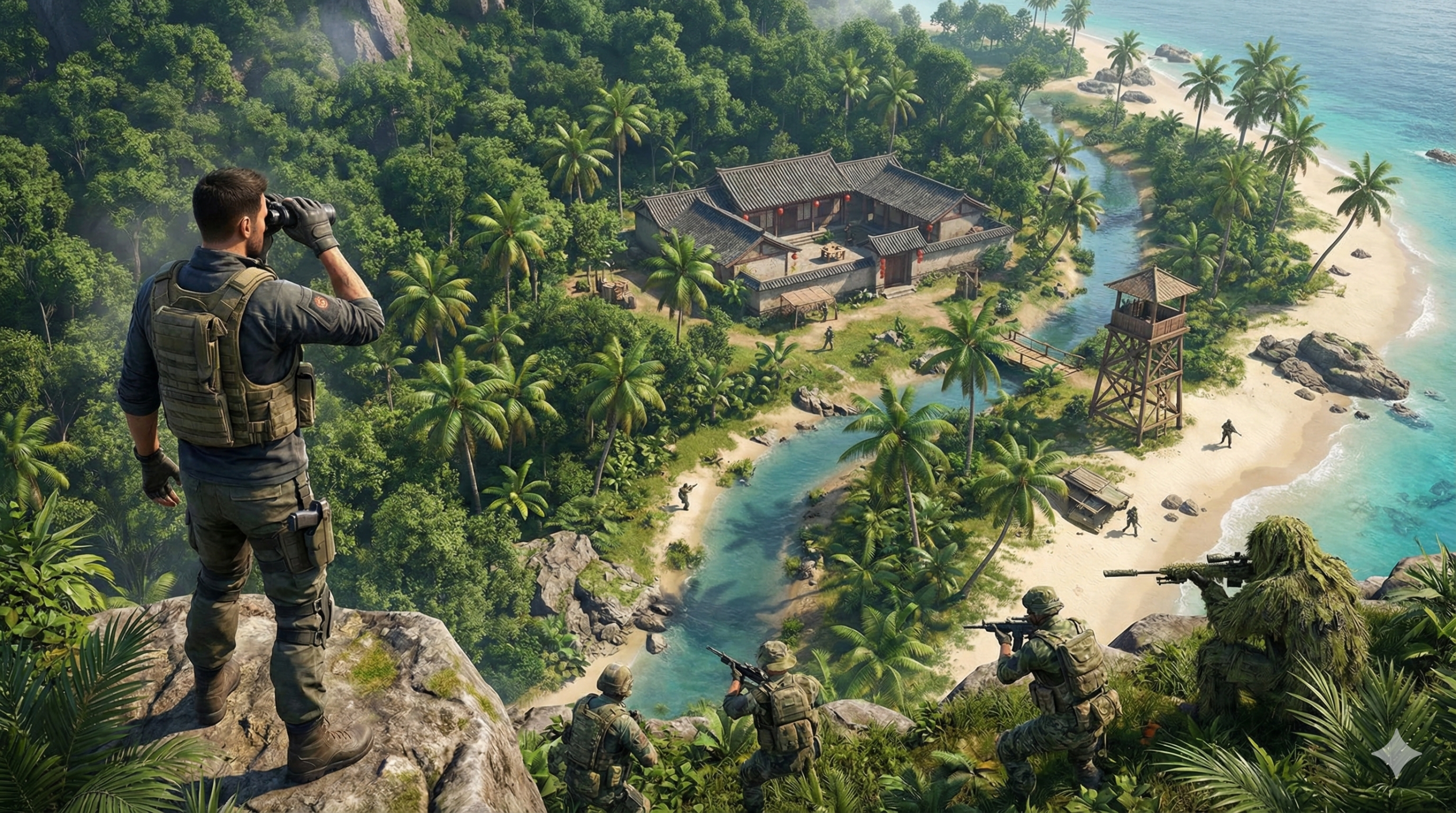
Sea fog clung to the island year-round, like a damp gray cloth wrapping around its shores. It had no official name; in the handful of encrypted briefings circulating internally, it was codenamed “Node.” But to those about to set foot on it, it felt more like a metaphor—a “Ant Reef” suspended between existence and non-existence.
Song Lan stood on the frigid deck of the transport ship, salt-tinged sea wind whipping at her short hair. Her shoulder insignia and armband had been removed beforehand; her dark training uniform bore no markings, resembling a patch of pure shadow. In her hand, she carried a standard-issue black equipment case, its surface scarred with white nicks from countless transports—her only “personal” trace in that moment. No, there was one more. Through the thick fabric of her uniform, the pad of her left index finger unconsciously brushed the edge of the inner pocket repeatedly. There, the corner of a rigid photograph pressed against her skin, a faint yet persistent sensation. She had pulled it from the deepest recesses of her wallet and slipped it in during the last second before boarding the ship—a crayon drawing. The sun in the picture was overly bright, three stick figures holding hands: the middle one wore a blue dress (her son had insisted mothers should wear dresses), with clumsy handwriting beside it: “Mommy stay safe, come home soon.”
“Home.” The word felt farther away than the sea beneath her feet. She knew that from the moment she stepped onto Ant Reef, the parts of “Song Lan” that were a mother and a daughter would have to be sealed away completely. What remained here could only be “Commander.”
The transport ship docked. No dockworkers, no officials for routine inspections—only a soldier in an identical unmarked uniform, standing motionless at the end of an extended makeshift trestle with a scanner in hand. The process was silent and efficient. The scanner’s cold green beam slid over her body and equipment case, emitting a steady hum.
“Identity confirmed. Proceed to Security Checkpoint One.” The soldier’s voice was flat, his gaze passing over her to the empty sea beyond.
Security Checkpoint One was a stark white, overly bright room—completely empty except for an isolated arch-shaped device resembling an airport security gate in the center, and a scanning tray in the corner.
“Please remove all personal items, including non-standard electronic devices, paper products, and accessories. Place them in the tray and pass through the scanning gate.” The instruction came from a wall speaker, a synthetic female voice unnervingly sweet.
Song Lan opened her equipment case and took out the issued encrypted communicator, tactical tablet, a blank notebook, and two pens. Then she paused for half a second. Her right hand slipped into the inner pocket; the moment her fingertips touched the photograph, it was as if a faint electric current surged through her. Instead of pulling it out immediately, she lingered, brushing the rough paper edge and slightly raised crayon marks once more with her fingertip. When she withdrew her hand, it was empty. The photograph remained hidden deep in the pocket. It was a small gamble—betting that the thickness of the fabric and the photo’s non-metallic, non-electronic nature would fool the gate.
She placed the standard items in the tray, which slid silently into the wall. She walked toward the scanning gate.
Hum—
As she passed through, the faint blue light strips on either side of the arch suddenly turned dark red, and a sharp, short alarm blared. A red light on a monitor in the corner flashed.
Song Lan’s heart contracted sharply, but her face remained impassive. She simply stopped and looked calmly at an observation window that had suddenly lit up to the side. There seemed to be figures behind it, but the glass was one-way.
“Please step back.” The synthetic voice said.
She obeyed. The arch’s blue light returned, and the alarm ceased. A technician in a white lab coat—his face equally indistinct—emerged from a side door, holding a palm-sized device resembling an old-fashioned radio. Without a word, he gestured for Song Lan to raise her arms, then moved the device slowly from the top of her head downward.
When the device neared her right chest, it emitted a soft “beep”—faint, but unmistakable.
The technician’s movements froze. Song Lan could feel the photograph in her inner pocket, its presence magnified infinitely, almost burning through the fabric.
Time stood still for roughly three seconds. The technician looked up, seemingly glancing at her through his lab coat and mask. His gaze was unreadable—not scrutiny, but something closer to… silent acknowledgment. Then he turned off the device and stepped back.
“Cleared. Retrieve your items and proceed to Preparation Area Two.” The synthetic voice sounded again, as if the earlier incident had never happened.
Song Lan collected her things from the tray and walked toward the door that had opened on the other side. As she passed the technician, an extremely soft voice—barely more than a breath—reached her ears: “It’s a nice drawing.”
Her footsteps didn’t falter; she walked straight into the dim corridor. But the edge of the photograph, rubbed countless times, still seemed to retain the inhuman cold touch from the technician’s device. Systems were cold, but those who enforced them were ultimately human. It was the first signal from Ant Reef—and the first crack in its armor.
Preparation Area Two resembled a spartan briefing room. Several people had already arrived. A burly man with a deep scar on his cheek leaned against the wall, eyes closed in rest. His left sleeve hung empty from the elbow down; beneath the uniform fabric, the rigid outline of a metallic structure was faintly visible—a military prosthetic interface with advanced neural integration. Zhao Weishan. The name popped up from her files. During a border skirmish, he had left himself in a minefield to drag back a wounded comrade. He wore no medals, but the calm, mountainous aura he carried from the battlefield was a decoration in itself.
A young man with glasses sat on a chair in the corner, fingers tapping rapidly in the air as if simulating a keyboard. His lips moved silently, his gaze fixed blankly on the ceiling, completely immersed in his own world. Cheng Yu. A genius in information warfare, and widely regarded as an “eccentric.”
There was also a woman, sitting upright, polishing a pair of headphones with extreme care using a soft cloth. Her movements carried a ritualistic focus, as if the headphones were an extension of her body. Lin Wan. A communications surveillance expert, said to be able to detect a target’s emotions from unencrypted background noise.
Song Lan didn’t greet anyone. She simply walked to an empty seat, sat down, and placed her equipment case at her feet. Silence filled the room, broken only by the low sigh of the ventilation system and the faint crash of waves. They were all waiting—for the last member, for the unspeakable mission that had brought them here to be officially revealed.
Footsteps approached outside, slightly hesitant. The door opened, and an extremely young soldier—still carrying the faint traces of a student—stepped in. Li Xiang, a new recruit with a resume consisting solely of training scores. His gaze swept quickly across the room, pausing for a fraction of a second on Zhao Weishan’s empty sleeve and the unusual “arm.” His pupils contracted almost imperceptibly. It was the instinctive reaction of someone untouched by war, confronting the physical legacy of conflict for the first time—not fear, but a mixture of awe, curiosity, and a faint, stabbing shock. He had seen “casualties” abstracted into report numbers; now they materialized as the silent metal and scars before him.
He quickly looked away, found a chair closest to the door, and sat down with his back straight, hands resting on his knees, knuckles white.
The last to arrive was Shen Yi, the psychologist. As he entered, his gaze drifted slowly over everyone, lingering for a split second on Song Lan’s slightly pressed lips, Zhao Weishan’s closed eyelids, Cheng Yu’s unconsciously tapping fingers, Li Xiang’s tensed shoulders, and the frequency of Lin Wan’s headphone-polishing. Only then did he sit silently in a position where he could observe everyone, taking out an unlabeled notebook.
Seven people. One missing.
A few minutes later, the room’s speaker clicked on. But instead of the synthetic voice, a slightly hoarse male voice with a strange rhythm emerged, speaking fluent Chinese with a faint accent: “Apologies. Calibrating the drone’s inertial navigation took longer than expected. Hope I didn’t hold things up.”
As the voice faded, Ali Musa walked in. He had dark skin and deep-set eyes, carrying a custom silver case with heat vents. He nodded at everyone present, his smile open and sincere, but there was a falcon-like sharpness deep in his eyes—honed by years of observing the ground from high above.
Eight people. All accounted for.
The screen at the front of the room lit up. No opening remarks, no welcome—straight to the point.
“Ladies and gentlemen,” the screen displayed a simplified global situation map, thousands of light points, flight paths, and identification frames flickering and moving at different frequencies, forming a silent, vast ocean of information. A calm male voice narrated, “The ‘Node’ where you stand is the seventh deep backup node of the ‘Great Wall’ Early Warning and Response System—and the only node that ‘does not exist’ logically. Your mission is not recorded in any public order sequence, nor will it generate any standard after-action reports. Your existence is a ‘blind spot’ in the system.”
On the screen, three distinct historical crisis points were highlighted, marked with “Resolved (conventional means).”
“However, assessments indicate that within the next six months, there are three highly probable critical conflict points that cannot be properly addressed by current standard procedures. Their triggers may stem from technical miscalculations, program vulnerabilities, or irrational emotional escalation.” The narrator paused, as if giving everyone time to process the cold information.
“Your task is to utilize the system’s ‘gaps,’ the ‘flexibility’ of rules, and the ‘additional information’ you are authorized to access at these critical points to ensure events veer onto a trajectory of ‘non-occurrence.’ In other words—”
The screen went dark, leaving only a line of white text glowing coldly in the dim room:
When war seems inevitable, ensure it “is avoided.” And your victory will be absolute silence.
The room fell deathly quiet. Only the waves, endlessly crashing against the reef, like a constant heartbeat from a distant time and space.
Song Lan’s fingers unconsciously touched the photograph in her inner pocket. It was cold. She looked at the line of text on the screen, yet somehow seemed to see beyond it—to the overly bright, unrealistic sunshine in her son’s drawing.
Silence is victory. For the first time, she felt the weight of that victory so tangibly—how void, yet how heavy it truly was.
Chapter 2: Strange Comrades
The first assembly after the order was issued took place in the cafeteria on the second basement level of Ant Reef.
The cafeteria was equally stark, bordering on harsh. No windows; the light was uniform, shadowless cool white. Four rows of long metal tables and chairs were bolted to the floor, their surfaces made of easy-to-clean composite material with slight wear on the edges. The air smelled of a mixture: disinfectant, cooking oil, and a faint ozone-like scent from the continuously operating large electronic equipment.
The eight people walked silently to the food counter. No menu—only three stainless steel thermoses containing oatmeal porridge, boiled eggs, and stir-fried dehydrated vegetables. The server was a middle-aged man with no markings, his eyes vacant, mechanically portioning food into each standard tray. Everything emphasized function over choice.
Song Lan carried her tray, scanning the cafeteria quickly. Instead of heading to an empty table, she chose one where two people were already sitting—Zhao Weishan and Cheng Yu. It was a silent commander’s directive: they needed to grow accustomed to each other’s presence, starting with sharing silence.
Zhao Weishan sat on one side of the table, his back straight. Beside his tray lay a pair of specially designed utensils, their handles thickened with non-slip grooves and small interface indentations. He didn’t eat immediately; instead, he picked up the spoon with his right hand, scooped a spoonful of oatmeal, and brought it to his mouth—chewing, swallowing. Throughout, his left arm—or rather, the metallic interface at its end—hung motionless at his side. The empty sleeve and the faint metallic glow of the interface felt like a silent declaration under the cool light.
Cheng Yu sat across from him, his head bowed almost to his tray. He didn’t touch the oatmeal; instead, he poked at the lumpy yellow-green dehydrated vegetables with his fork, his brows furrowed. His lips moved silently, as if calculating something. With his right hand, he tapped an intricate rhythm on the greasy tabletop unconsciously.
When Song Lan sat down, Cheng Yu seemed startled, looking up suddenly. His eyes behind his glasses flashed with confusion before he retreated back into his own world. He stopped tapping, carefully pushed the vegetables aside with the tip of his fork to reveal a few overcooked, cracked boiled eggs underneath. Staring at the slightly solidified yolk oozing out, his Adam’s apple bobbed, as if struggling to suppress a sense of discomfort.
“Protein and vitamin ratio is irrational,” he suddenly said, his voice soft but rapid, more to himself than anyone else. “Insufficient fiber, single type of fat, glycemic index… This standardized nutrition plan supports sustained high-intensity cognitive work at 17% below optimal efficiency. Why haven’t they optimized the algorithm? There are clearly better solutions in the logistics database.”
Song Lan calmly scooped a spoonful of oatmeal and took a bite. It was lukewarm, tasteless. “This isn’t a laboratory, Engineer Cheng,” her voice was quiet but clear, with undeniable authority. “This is the frontline. Stability, controllability, and no allergens are more important than ‘optimal solutions.'”
Cheng Yu opened his mouth as if to argue, but ultimately just bowed his head, stabbing at the vegetables more vigorously. He picked up a boiled egg, peeling it clumsily and irritably, leaving bits of egg white scattered on the table.
On the adjacent table, Li Xiang hesitated for a moment before sitting down alone. His gaze involuntarily drifted to Zhao Weishan’s left arm. He watched as Zhao Weishan steadily picked up a boiled egg with his right hand, tapped it gently against the edge of the tray, and peeled the shell deftly—smoothly, like anyone else. But when Zhao Weishan set the egg down and picked up the specially designed fork, preparing to spear the vegetables, Li Xiang noticed something different: Zhao Weishan’s left shoulder moved ever so slightly.
Immediately afterward, a series of faint “click” sounds emanated from the empty sleeve—like the engagement of precision gears. Then, from the cuff, several matte black metallic “fingers” emerged, stabilizing the tray firmly against the table edge, making it easier for the right hand to pick up food with the fork.
It wasn’t a humanoid hand, but more like a multi-functional clamping device. Yet its appearance and movements carried an inhuman yet surprisingly efficient coordination.
Li Xiang felt his breath catch. He had seen advanced military prosthetics in promotional videos, but witnessing the physical legacy of war intervene in such a mundane, functional way in daily life was an indescribable shock—more real than any battlefield footage. He had seen “casualties” abstracted into report numbers; now they materialized as the silent metal and scars before him.
He quickly looked away, staring at his own tray, but his throat felt tight, and he had lost his appetite.
Shen Yi sat in the corner of the cafeteria, his unlabeled notebook open in front of him. He didn’t touch his food; instead, he sketched rapidly with an ordinary pencil—not words or complete drawings, but abstract lines, symbols, and occasional timestamps. His gaze drifted casually over everyone: Song Lan’s upright posture even while eating (self-control); Cheng Yu’s avoidance of food and table tapping (anxiety, sensory sensitivity); Zhao Weishan’s absolute calm while using assistive tools (acceptance and integration); Li Xiang’s momentary shock and avoidance (impact and initial adaptation); and Lin Wan and Ali Musa, sitting alone at the farthest table.
Lin Wan had already finished her precisely portioned meal. Instead of leaving, she took a pair of extremely thin headphones from her bag, connected them to her tactical tablet, and closed her eyes. Her fingers tapped a rhythm lightly along the edge of the tablet, her brows furrowed—as if searching for a specific frequency or pattern amid the cafeteria’s background noise: the clink of metal utensils, the hum of distant vents, occasional coughs. She was practicing “listening.”
Ali Musa ate slowly and carefully, treating the bowl of oatmeal as if it were something worthy of respect. His gaze occasionally drifted to an inconspicuous vent grille in the corner, as if he could see through the concrete and pipes to the fog-shrouded sky outside. His fingers traced gentle arcs on the tabletop, simulating the push and pull of a joystick. When his eyes met Shen Yi’s from across the room, he smiled openly, with a hint of apology, before returning his focus to his tray or his “simulated flight.” His detachment was gentle, a calm acceptance of being “elsewhere.”
Chen Yan was the last to enter. He carried his tray, pausing near the food counter to scan the entire cafeteria with sharp eyes—like analyzing a complex chart, absorbing everyone’s positions, postures, and interactions (or lack thereof). Only then did he walk to an empty table near the information display screen (currently dark) and sit down. He didn’t eat immediately; instead, he took out his encrypted reader and browsed quickly, occasionally taking a bite of the cold boiled egg. Even at rest, his mind seemed to process information streams, trying to piece together valuable “background intelligence” from the fragmented behaviors of these strange comrades.
Silence persisted, but it was no longer empty. It was filled with the clink of metal against trays, the faint hum of electronic devices, restrained chewing, and the silent turmoil in each person’s mind.
Cheng Yu finally abandoned his vegetables and turned to the oatmeal. He took a sip, his brows furrowing deeper, and slammed the spoon down.
“Temperature 3.5 degrees Celsius below optimal, viscosity exceeding standards,” he muttered, his fingers tapping the table again, the rhythm more agitated. “Affects swallowing efficiency and gastric comfort. Why isn’t this variable controlled?”
His voice was soft, but in the quiet cafeteria, it stood out clearly.
Zhao Weishan stopped eating. He turned to Cheng Yu. His face was like weathered rock, the scar more prominent under the cool light. He didn’t speak; instead, he held out his right hand—the intact one, calloused and covered with small scars.
Cheng Yu froze, confused.
Zhao Weishan pointed to Cheng Yu’s tray, then made an extremely simple gesture: closing his fingers as if gripping a spoon, then lifting his wrist steadily to his mouth.
The gesture for “eating.”
Then he pulled his hand back and resumed eating his own now-cool food. His metallic assistive arm had retracted silently into his sleeve, as if it had never appeared.
Cheng Yu stared blankly at Zhao Weishan, then down at his bowl of oatmeal, which he had been complaining about. A look of confusion crossed his face, followed by realization. He said nothing, picked up the spoon again, and instead of overthinking temperature, viscosity, or nutrition curves, he began eating the oatmeal bite by bite, as if completing a necessary procedure.
Li Xiang watched the entire exchange. He saw what lay behind Zhao Weishan’s simple, almost awkward gesture: a fundamental survival logic beyond technical parameters and nutrition algorithms. Here, eating to maintain strength was the core “optimal solution.” Suddenly, the bland food on his own tray no longer seemed so unpalatable. He picked up his spoon and began eating, his movements less tense.
Song Lan observed everything silently. She finished the last of her oatmeal and wiped her mouth carefully with a napkin. Good. The first lesson had begun in the most unassuming way—how to find a minimal common ground and survive in an environment stripped of normalcy, amplified differences, and tasked with the impossible.
In his notebook, Shen Yi drew a faint line between Cheng Yu’s and Zhao Weishan’s names, marking a small symbol beside it: ⊕ (Integration). Next to Li Xiang’s name, he drew an upward arrow, writing: Cognitive restructuring (in progress).
The cafeteria lights remained stark white. Outside, the fog and waves were blocked by thick concrete and soundproofing, leaving only a heavy silence nurturing unfamiliarity and tentative exploration. But for the first time, that silence held a faint, human warmth—like the first spark struck in darkness: weak, yet undeniably real.
Chapter 3: The System’s Skin
The command center was located ninety meters underground on the island.
The journey there was a process of stripping in itself. They passed through three airtight doors; each time one closed behind them, it sealed off the outside world—even other areas of the base—completely. The air grew increasingly dry, carrying the sterile freshness of ion filtration, yet lacking vitality. Before the final door, they each pressed their palms against a biometric panel, and a red light from a retinal scanner slid across their pupils.
“Authorization confirmed. Welcome to the ‘Great Wall’ Seventh Node Core Operations Area.”
The door slid open silently.
The first shock was light.
Not the uniform, shadow-eliminating cool white of the cafeteria, but layered, flowing, directional light. A massive circular main screen spanned the curved front wall, six meters tall, currently displaying a simplified global situation map. Thousands of light points, flight paths, and identification frames flickered and moved at different frequencies, forming a silent, vast ocean of information. The screen itself did not emit light; the source came from hidden arrays behind and above it, making the image appear as if suspended in the dark void like a star chart.
Beneath the main screen, two rows of stepped operation terminals were arranged. Each terminal was equipped with multiple auxiliary displays, angled slightly to prevent glare from the main screen. The partitions between terminals were tall, providing necessary privacy and focus, but temporarily isolating everyone in their own information islands.
There was sound in the air. Not noise, but a composite low-frequency hum: the continuous breathing of the server cluster’s cooling fans, the circulation of fluids in various cooling systems, the electromagnetic pulses from fiber optic switches blinking millions of times per second—imperceptible to the ear but felt in the body. There was also an extremely faint “hiss” like white noise from the air purification and pressure maintenance systems.
The moment Li Xiang stepped inside, he involuntarily held his breath for half a second. It wasn’t nervousness, but an instinctive reaction to the pressure of a massive entity. He had trained on command information systems, but the scale, complexity, and cold beauty of what lay before him far exceeded any exercise center he had ever seen. Data was no longer abstract numbers on a screen, but tides surging in this sea of light.
“Individual terminals activated, labeled with temporary codenames C1 to C8.” The synthetic voice announced. “Please perform initial system adaptation and authorization verification. Standard operating procedures are preloaded, but note that some functional modules of this node operate under ‘extended protocols.'”
Song Lan walked straight to the central, slightly forward position marked C1. Instead of sitting immediately, she hovered her palm over an inconspicuous gray area above the console. A blue light scanned it, and the five screens in front of her lit up one by one, displaying different content: encrypted communication status and node system health monitoring on the left; two filtered views of the main situation in the middle; and a summary of team members’ physiological status monitoring on the right (currently only basic vital signs—heart rate, blood pressure, etc., but the interface indicated access to advanced neural stress indicators was available).
She sat down, her back still straight, and began browsing the interface quickly. Her movements were precise and decisive, no wasted gestures. She was familiarizing herself with the “skin”—the system’s external feel and response logic.
Cheng Yu (C3) almost pounced on his terminal. He adjusted his chair to a strange angle, leaning slightly sideways, his fingers already flying across the keyboard, leaving afterimages. His screens didn’t just light up—they “exploded”—instantly popping up more than twenty overlapping windows, code streams cascading like waterfalls. He was accessing underlying system logs, diagnostic protocols, and communication handshake records usually hidden from operators. His glasses reflected scrolling hexadecimal strings and waveform graphs, his lips moving silently, a look of almost ecstatic focus on his face. To him, the system was not a tool, but a living entity to be disassembled, conversed with, even debated.
“Latency 12 milliseconds higher than standard nodes, but three additional redundancy check paths… Interesting. Is this intentionally introduced ‘buffering’?” He muttered to himself, completely immersed in another dimension.
Lin Wan (C4) was the opposite. She put on her thin headphones first before activating her terminal. Her main screen displayed a global heat map of communication link loads and spectrum occupancy, colorful blocks resembling abstract art. But she barely looked at it; instead, she closed her eyes, her fingers resting lightly on a special knob on the console, turning it slowly. She was “listening” to the system. Through the headphones and proprietary decoding algorithms, she could convert encrypted communication metadata (not content) directly into perceptible audio streams—different protocols had distinct “tones,” data volume manifested as “volume” fluctuations, and abnormal retransmissions or error checks emitted specific “static.” At that moment, her brows furrowed, and she stopped turning the knob.
“Northeast Asian region, K-band satellite relay. Background noise contains 0.3% abnormal harmonics, appearing regularly. Not natural interference.” She spoke clearly and calmly, her eyes still closed. “Recommend running a 底层 diagnostic. Possible hardware degradation, or… non-standard embedded signals.”
Song Lan glanced at the corresponding item on her monitoring screen; no abnormalities were displayed. “Logged. Cheng Yu, assist with the check.”
“Already on it.” Cheng Yu didn’t look up, three windows switching instantly to telemetry data from the relevant satellite. “Give me ten seconds… Not hardware. Residual test signals from an outdated, incompletely erased protocol—version 7.4a, obsolete three years ago. Harmless, but consuming minimal resources. Can be cleared.”
“Approved for clearance.” Song Lan said. A small collaboration completed in a few words.
Zhao Weishan (C2) sat to Song Lan’s left. He activated his terminal in a unique way. First, he completed the standard biometric scan with his right hand, then pressed the metallic interface of his left arm gently against an unmarked indentation on the side of the console. A few nearly inaudible “clicks” came from the interface as it established a physical connection with the system. The content on one of his auxiliary screens changed instantly—no longer the general situation, but a highly detailed integrated view of real-time dynamics, supply status, and even estimated morale indices (based on communication volume and patterns) of specific types of military units, especially ground heavy forces and forward outposts. It was part of his “additional authorization”: systematic presentation of near-battlefield intuition.
Instead of extending the clamping device as he had in the cafeteria, he integrated his neural signals (translated) deeply with system controls through this direct connection. When he needed to zoom in on an area or retrieve past operation records of a unit, he barely needed to search for menus or input commands manually—a thought-driven micro-movement, supplemented by confirmation with his right hand, and the operation was complete. Efficient, silent, with a cold precision of man-machine integration.
Li Xiang (C8) struggled to process everything. His terminal interface was relatively standard, but the density of information still made him dizzy. He tried to understand the meaning of each data block one by one according to the training manual, only to find that many abbreviations and symbol combinations did not exist in the manual. He glanced secretly at Chen Yan’s (C5) screen nearby. Chen Yan was cross-referencing three intelligence summaries from different sources, his fingers sliding quickly across the trackpad, his eyes sharp as an eagle’s, occasionally making marks only he could understand in another window. Li Xiang looked away, took a deep breath, and decided to start by identifying a few key friend-or-foe identification icons on the main screen.
Shen Yi (C7) did not rush to operate the complex system. He pulled up a relatively simple interface: team collaboration status monitoring. It displayed data exchange frequencies, communication latency, and each person’s response time to system commands in abstract graphics. He opened his unlabeled notebook, and on a new page, began sketching eight dots, marking their initial interaction patterns with different lines and symbols: solid arrows for the brief command chain between Song Lan, Cheng Yu, and Lin Wan; dashed lines for Cheng Yu’s immediate response to Lin Wan’s discovery; Zhao Weishan operating independently but deeply integrated with the main system… Ali Musa (C6) was somewhat different.
The screen in front of Ali displayed a global hot spot map of drone activity and airspace control status. But at that moment, he was connecting a small portable terminal to the main system via a cable, uploading something. After the upload was complete, a new, continuously adjusting window appeared in the corner of his main screen—showing ultra-high-precision real-time synthetic aperture radar images of a specific area (terrain resembling the junction of Central Asian deserts and foothills), detailed enough to distinguish dust clouds raised by moving small vehicles.
“Personal interest?” Song Lan’s voice came over the communication channel, direct and calm.
Ali turned his head and smiled—a smile that seemed particularly sincere under the command center’s cool light. “Something like that. Also calibration. My ‘eyes’ are used to seeing the ground at this scale. Keeping my skills sharp. Besides,” he pointed to a few almost stationary dots in the corner of the image, “this is an uninhabited area near my hometown. Occasionally… some ‘guests’ pass through. Just checking if they’re behaving today.”
Song Lan fell silent for two seconds. “Restrict to this area only. No active scanning or marking. Logged as ‘terrain calibration training.'”
“Understood.” Ali nodded, his smile fading as he returned to focus.
Just as everyone was gradually immersing themselves in the feel of their respective system “skins,” a section of the main screen’s edge—originally displaying a calm light blue sea area (near friendly coastlines)—suddenly flickered with a pale yellow border, quickly turning amber. An identification frame popped up, labeled “UNKN-B-22,” with course, speed, and altitude data updating rapidly.
“Unauthorized aircraft detected entering the edge of friendly identification zone,” the synthetic voice reported, still calm. “Based on signal characteristics, identified as ‘ally’ EF-18 electronic reconnaissance aircraft. Callsign not in scheduled mission list. Standard protocol activated: Level 1 radio warning, requesting identification and immediate course change.”
On the main screen, two green dots representing friendly patrol aircraft began moving toward the amber dot. The standard response process unfolded automatically.
Chen Yan immediately pulled up more information: “EF-18 from the ‘Spade’ Squadron. This unit has been active in the area frequently. This intrusion… the trajectory is subtle, just skirting the edge of the identification zone. It’s like testing response thresholds, or,” he paused, “collecting response characteristics of our air defense command chain.”
Lin Wan opened her eyes, adjusting the knob quickly with her fingers: “Receiving public frequency broadcast from the target. Content includes standard identification and ‘navigation error’ claim, but…” She listened intently. “There are abnormal harmonics in the underlying modulation of the broadcast signal, slightly different from the standard communication characteristics of EF-18s. They’re conducting passive signal collection simultaneously—87% probability.”
The standard process continued: second warning, friendly aircraft closing in, issuing radar lock simulation signals.
Song Lan watched the screen. According to standard rules of engagement (ROE), if the target continued to penetrate or made hostile moves, the next step would be more deterrent actions, possibly even leading to exchanges of fire. And the target’s behavior was indeed probing the edge.
“Recommend escalating response,” Chen Yan’s voice carried the calm of an intelligence officer. “We must clarify our bottom line. Otherwise, it will be seen as weakness, and subsequent probes will intensify.”
But Ali shook his head, his gaze not leaving his screen: “I know the commander of the ‘Spade’ Squadron. He’s cautious. This kind of risk-taking isn’t like him. It’s more like… an ‘observation’ order from higher-ups. If we overreact, we’ll precisely provide the ‘hardline response’ data they want—playing right into their hands.” He pulled up a regional troop deployment diagram. “Look here. They have a support ship nearby. If shots are fired, they have the means to withdraw quickly and conduct diplomatic maneuvering. We, on the other hand, will be passively drawn into an ‘accidental’ dispute.”
Li Xiang’s heart raced. The standard process was clear, but reality had suddenly become so complex—filled with speculation, gamesmanship, and potential multiple traps.
Song Lan’s fingers tapped gently on the console, a steady rhythm. “Lin Wan, send an encrypted directional message via ‘Channel-7,’ using old harmonic encoding. Content…” She paused for a second. “‘The eagle sees the sparrow dancing on the fence. Windy, be careful.'”
A look of understanding flashed in Lin Wan’s eyes: “‘Channel-7,’ harmonic encoding. Message generated… sent.” Her fingers typed the seemingly bizarre sentence on a dedicated keyboard. It was not standard military communication, but an ancient code understandable only to specific recipients.
At the same time, Cheng Yu moved quickly, making subtle modifications to a system log entry for the incident—slightly delaying the response time of the “Level 1 radio warning” by 0.5 seconds, and adding an irrelevant system self-test note in the log. He was creating an insignificant, explainable “gap.”
Seconds later, on the main screen, the amber dot—just as it was about to meet the green dots—suddenly changed course, arcing smoothly away from the identification zone. At the same time, Lin Wan received a response using the same old harmonic encoding, just two words: “Received. Clear skies.”
The alert was lifted. The amber dot returned to a harmless blue, eventually disappearing from the screen’s edge.
In the command center, the low-frequency hum resumed.
In his notebook, Shen Yi circled the incident, marking: “First non-standard collaboration: Successful. Decision model: Commander’s intuition (Song) + Technical interference (Cheng) + Signal deception (Lin) + Regional intelligence assessment (Ali, Chen). Controversy: Hardline (Chen) vs. Circumspect (Ali). Li Xiang: Observation, impact.”
Li Xiang looked at the calm screen, cold sweat breaking out on his back. No gunfire, no intense confrontation, not even a single exchange of words that could be recorded in an official report. Yet in those tens of seconds, a potential conflict had been quietly steered in another direction through a coded message and a 0.5-second delay—within the gaps of the system.
For the first time, he truly understood how delicate and subtle the operation of “avoiding war” was, and how dangerously close it walked the edge. It required more complex nerves and heavier responsibility than pulling a trigger.
Song Lan’s voice broke the silence, as calm as ever: “Drill record filed as ‘routine identification zone control exercise.’ Everyone, continue system adaptation. Our work here has just begun.”
On her screen, the global situation map remained vast, countless lights flickering on and off. And beneath that calm surface, for the first time, they—acting as a whole—had touched the cold, complex, yet flexible flesh and bones beneath the system’s “skin.”
Chapter 4: Undercurrents of Memory
The simulation was labeled “routine,” but the real neural energy it consumed could not be so easily filed away. Four hours after system adaptation, a mandatory rest period began. The command center’s lights were dimmed to minimum maintenance brightness; the low-frequency hum persisted, but the space felt much emptier. The eight people scattered, driven by their biological rhythms and the brief offline time allocated by the system, returning to their personal cabins—dubbed “cells”—on the island.
The cabins were uniformly sized, with sound-absorbing light gray composite walls, a narrow bed bolted to the wall, a foldable table built into the wall, a chair, and a mini bathroom. No windows—only a dimmable ceiling light that offered no warm tones. Once the door closed, it was absolute isolation, carefully wrapped in technology. This was the only place where memories were allowed—or rather, forced—to surface.
Song Lan didn’t turn on the ceiling light, letting only the faint emergency light by the door cast vague outlines. She sat on the edge of the bed, the slightly worn crayon drawing in her palm. In the absolute silence, she allowed herself to look at it carefully for the first time. Her son had drawn the sun with jagged edges, like a clumsy yet fiery heart. The blue dress’s paint had spilled over the lines—a sign of his impatience at two and a half years old. “Mommy stay safe, come home soon.” The character for “home” was crooked, its last stroke stretched long.
Instead of touching the drawing, her fingertips hovered over the character for “home.” Home. At this moment, the word felt like a gentle trap. She remembered three years ago, during a standoff along the border actual control line. An enemy helicopter had suddenly approached a friendly outpost under the pretense of mechanical failure. She had been the duty officer at the forward command post. The standard procedure was to warn and drive it away, but the enemy’s posture was extremely dangerous. The young radar operator’s voice was tight: “Lock-on complete. Requesting instructions.” In her headphones, she heard the calm urging of the rear command post and the heavy breathing of the frontline company commander. On the screen, the light dot kept approaching the red boundary. She remembered her own voice, cold as iron on a frozen plain: “Maintain lock-on. If it crosses the line, execute contingency plan.” Contingency plan—a word that included the option to open fire. At that moment, there were no images or sounds in her mind, only a blank after rapid calculation. In the end, the helicopter pulled up and turned at the last second, leaving behind a cloud of snow dust stirred by its rotor. In the post-incident summary, she was praised as “calm and decisive.” Only she knew that before issuing that order, her mind had flashed with the warm touch of her young son clutching one of her fingers before bed—and the illusion of that touch being instantly stripped away and frozen. Now, her orders had changed from “execute contingency plan” to “send coded message” and “delay by 0.5 seconds.” Avoiding pulling the trigger required tearing against an instinct far more than pulling it. The sunshine in the drawing burned her palm. She carefully tucked the drawing back into her inner pocket, lay down, and stared at the empty darkness above. Come home soon. Perhaps she could return only when there was no longer a need for “avoidance” here.
Zhao Weishan went to the physical training room on the third basement level. It was open 24/7, with simple but sturdy equipment. Instead of a treadmill or rowing machine, he walked straight to the weightlifting area. He didn’t use his right hand; instead, he approached a specially designed squat rack equipped with complex clamps and sensors. He aligned the metallic interface of his left arm with an adapter on the rack—click, locked in place. Then he adjusted his posture, his back as rigid as steel, core tensed, right arm hanging naturally at his side. His gaze fell on his reflection in the mirror ahead, and on the empty right sleeve hanging down in the reflection (he habitually removed the prosthetic itself during non-direct operations to reduce neural load and avoid unconscious movements).
He took a deep breath, tensed his legs, and began lifting the heavy barbell with his left arm—the metallic interface connecting to the weight. The weight number on the nearby screen jumped, far exceeding what a normal person could lift with one arm. The metal bar rose steadily along precision rails, veins bulging in his neck, the scar on his cheek standing out sharply under the overhead lights. Sweat broke out quickly, sliding down his temples and into his collar.
At the moment the barbell reached its peak, muscles and machinery bearing the maximum tension, the edge of his vision blurred—specifically, the empty right sleeve in the mirror. No, not blurred—covered by memory.
It wasn’t the training room’s sound-absorbing walls, but the hot, humid rocks of the southern border. Not the smell of iron from the barbell, but the stench of gunpowder, dirt, and… the sickly sweet smell of burning flesh. The explosion wasn’t distant, but beneath his feet—dull, then a deafening roar and searing light. Sound was stripped away first, the world becoming a silent film, only violent vibrations so intense they made him nauseous coming up from the ground, through his boots, straight to his spine. Then color was drained, everything before his eyes rapidly fading to flickering black-and-white static, like an old TV losing signal. No pain—at first. Only a strange feeling of being instantly “combed” by a massive force, followed by an indescribable “emptiness” where his right arm should be. And then, not from the wound, but from the depths of his brain—unable to comprehend this “emptiness”—a primal, burning fear. He looked down, seeing twisted metal, splattered dark red, and a fragmented… limb that didn’t belong to any cognitive category. Is that mine? The thought barely formed before a stronger instinct took over: Drag him! Drag the still-breathing comrade back! Left arm still works! Claw at the rocks! Crawl!
The barbell was lowered steadily back onto the rack with a heavy thud. Zhao Weishan released the interface, stepped back, and gasped for breath, sweat dripping onto the rubber floor. In the mirror, his face was pale, but his eyes remained calm. He raised his intact right hand to wipe the sweat from his face, then slowly placed his palm over the hideous scar on his cheek. His rough palm felt the uneven texture of the skin. He didn’t look at the empty sleeve, but at his intact left arm and the now-empty metallic interface it had been connected to.
“They’ll never know,” he mouthed silently to his reflection, his voice so low only he could hear. “How lucky they are.” Lucky enough to face only amber light dots on a screen, not the moment when color and sound are stripped away. He twisted open a bottle of water, drank it in one gulp, and turned to leave the training room. His back remained as solid as a mountain, but his sweat-soaked shirt betrayed the immense effort of that brief confrontation with the abyss of memory.
Taking advantage of a short, authorized “surface breathing period,” Ali Musa went to a small observation platform on top of the base, surrounded by high walls. The fog still clung tightly, visibility less than fifty meters. The sea wind blew against him, carrying cold, damp moisture. He didn’t mind; he just leaned against the cold metal railing, opened his reinforced tablet, and quickly entered a long encryption key. The screen lit up, displaying not a military network, but a commercial satellite map. His fingers zoomed and panned skillfully, finally focusing on an area covered with yellowish-brown gullies, with scattered green and gray patches (possibly abandoned villages) on the edges. The coordinates were precise.
He zoomed in further. The image resolution was high enough to see wind-eroded landforms, dry riverbeds, and… a blurred mound of rubble and dirt. Once, there might have been low adobe walls, a courtyard. Now, only a raised area almost indistinguishable from the surrounding land remained. No signs of life.
Ali stared at the ruins, his lips pressed into a thin line. His fingertips hovered over the screen, trembling slightly—not from the cold. After a few seconds, he suddenly locked the screen, pressed the tablet to his chest, and looked up, taking a deep breath as if trying to penetrate the fog. The fog felt like a cold gauze covering his mouth and nose. He closed his eyes. There were no explosions in his ears (that had happened long ago, when he was too young—only a dull thud and persistent tinnitus remained in his memory), no cries (his mother had covered his ears with her hands, pressed his face to her chest—only the smell of fabric and dirt). There was only the real sound of waves crashing against the reef at this moment—monotonous, repetitive, as if trying to wash away everything.
He opened his eyes again, looking into the depths of the fog. Something in his gaze was carefully tucked away, regaining its sharpness and calm. He put the tablet away securely and turned to walk down the platform. The stairs leading underground were bathed in pale light, his shadow stretching long on the wall—like an eagle folding its wings and retreating to its nest.
Cheng Yu curled up on his cabin bed, wrapping his head tightly in a thin blanket. A severe, throbbing migraine had struck—common after high-intensity information processing. Even with his eyes closed, distorted light spots and colored streaks danced before him, accompanied by nausea. Painkillers were on the nightstand, but he resisted the medication that would dull his thinking.
In the tide of pain, he felt as if he had been washed back to an earlier time. Elementary school classroom, afternoon, harsh sunlight. Children were noisy, but he had been mocked by his deskmate for answering an advanced math question from the teacher (using a method he had derived himself, but which didn’t follow the textbook steps)—called a “freak” and a “show-off.” The laughter merged into an incomprehensible, terrifying noise. He opened his mouth to explain, to show how elegant and concise the logic was, but his throat tightened, only allowing broken gasps. The more anxious he became, the worse his stutter got, and the louder the laughter. Finally, he lowered his head, staring at the row of neat binary decorative patterns printed on his pencil case (01001000 01100101 01101100 01101100 01101111—”Hello”). Only those 0s and 1s were quiet, orderly, eternal. They didn’t laugh; they followed the purest logic. He stretched out his finger, touching them one by one, muttering silently: 0, 1, 0, 0… In the clear grid of binary, the world restored order, and the noise faded away.
Under the blanket, Cheng Yu’s fingers tapped an intricate rhythm based on prime numbers unconsciously and weakly on the bed sheet. The headache didn’t subside, but the ancient sense of suffocation that came with the memory gradually eased with the regular touch of his fingertips. He needed order—even order in pain. The cold logs and precise protocols at the bottom of the system were the air he breathed. He vaguely thought that tomorrow he should adjust the color frequency of the visual interface; perhaps it would reduce some neural load… His thoughts drifted in the pain, and he slipped into a semi-conscious state.
Lin Wan didn’t stay in her cabin. After requesting permission, she went to a quiet corridor on the periphery of the command center leading to the backup power facilities. She was allowed to stay here, and there was an old, grid-like vent that continuously carried clearer background noise—mixing mechanical operation and waves—than the center itself. She sat down against the wall, putting on her headphones again, but not connecting them to any device. She just closed her eyes and listened.
The hum of the vent, the faint turbine sound in the distance, the regular crash of waves far away, weakened by layers of structure… Beneath these sounds were her own breathing and heartbeat. She was practicing stripping away, distinguishing, reconstructing. Gradually, the real sounds faded, and memories emerged. It was a night in the diplomatic apartment of her childhood. She couldn’t sleep and sneaked to the study door. Warm yellow light and her father’s deep voice seeped through the crack. But clearer was the sound from her mother’s side—her mother wearing headphones, the telegraph machine in front of her emitting steady, rapid “beep-beep” sounds. It wasn’t Morse code; it was more complex, denser—like the regular chirping of some metallic insect. It was the first “lullaby” she had learned. Her mother typed quickly, occasionally pausing to think, her profile appearing focused and graceful under the desk lamp. Those “beep-beep” sounds weren’t noise to her; they were a safe, reassuring rhythm, a sign that the adults were handling important matters. Later, she learned it had been encrypted communication during an emergency diplomatic mediation. Those sounds were connected to great events far away, and to the faint light of her mother.
In the corridor, Lin Wan’s lips curved slightly in the darkness. She took off her headphones, and the sound of wind, machinery, and waves rushed back in. But she felt calm. She was good at finding signals in noise—perhaps, originally, it was to identify and hold onto that trace of “clear sound” similar to the childhood telegraph machine, representing order and mission, amid the complex sounds of reality.
Li Xiang sat at the foldable table, an unused notebook (issued) spread out in front of him. He held a pen, but couldn’t bring himself to write for a long time. Images from the day swirled in his mind: Zhao Weishan’s silent assistive arm, the advance and retreat of the amber light dot on the circular screen, the strange coded message “The eagle sees the sparrow,” Cheng Yu’s ecstasy in the code streams, the fleeting look in Ali’s eyes when he mentioned his “hometown”… None of these could be accurately summed up by any military regulations or philosophical concepts he had learned.
He tried writing “asymmetric response,” then crossed it out. Wrote “system flexibility,” but found it too cold. Finally, he wrote five characters forcefully:
The Weight of Silence
The tip of the pen almost pierced the paper. Looking at the five characters, he still felt powerless. Was this weight the past borne by Zhao Weishan’s empty sleeve? The look in Commander Song Lan’s eyes when she tucked away the photograph? The blurred ruins on Ali’s tablet map? Or the faint fear and heavy longing in his own heart for the responsibility of “avoidance” he was about to bear (even as an observer)?
He closed the notebook. For now, this weight was beyond his ability to put into words.
In Shen Yi’s cabin, the lights were bright. His unlabeled notebook was open on the table; the latest page featured eight simple humanoid symbols, surrounded by annotations, arrows, and question marks. He didn’t record specific memory content (that was impossible and unethical), but he recorded “signs”: the frequency with which Song Lan unconsciously touched her inner pocket before leaving the command center (+3%); the time it took Zhao Weishan to regain steady breathing after training (slightly longer than estimated for physical exertion); the increased frequency of Cheng Yu’s nervous tics during offline time (indicating possible discomfort); the duration of Ali’s requested surface stay and changes in pupil light adaptation upon return (suggesting he had stared at something in the dark); Lin Wan’s pursuit of specific frequency ambient sounds; Li Xiang’s act of taking a new notebook (seeking a cognitive anchor)…
Next to each person, he marked potential stressors, coping mechanisms (constructive/avoidant), and estimated “trigger points” that had not yet emerged. His job was not to judge, but to map a potential psychological terrain. When the real crisis came, knowing which “ground” might suddenly collapse could be just as important as knowing the enemy’s deployment. Next to Song Lan’s symbol, he drew a small shield and a smaller house icon protected by the shield. Next to Zhao Weishan’s, a bolt of lightning connected to a stable anchor. Next to Ali’s, an eye with a distant point in its pupil.
He closed the notebook and rubbed his eyebrows. Memories were undercurrents, but also cornerstones. These pasts, soaked in glory or pain, were quietly building breakwaters for them to face the unspeakable future on this gray isolated island. But when the tsunami truly came, would these dikes built from personal history grow stronger, or crack first from within?
He turned off the light and sat quietly in the darkness, listening to the eternal sigh of the ventilation system. He knew he was also on this topographic map—somewhere, at a coordinate not even he fully understood.
Epilogue: Proxy War
Late at night, the alarm blared again in the Ant Reef command center. This time, the glowing dots erupting on the main screen were not isolated—seven locations along the entire eastern disputed coastline lit up almost simultaneously: red triangles representing enemy small fast attack craft, green squares for friendly coast guard patrol ships, and unidentified aerial targets suddenly appearing near several key reefs.
Intelligence flooded in, contradictory and chaotic:
“Radar detects enemy aerial targets penetrating territorial waters at low altitude!”
“Friendly 03 Reef radar station reports electronic suppression!”
“Encrypted communications intercepted between enemy fleets. Keywords: ‘Eliminate,’ ‘Occupy,’ ‘Fire authorization’!”
“Friendly coast guard vessel ‘Zhulang’ (Wave Chaser) reports being locked by enemy fire control radar!”
Chen Yan’s voice was tight: “This is a coordinated attack! Scale far beyond probing! The enemy has dispatched at least three speedboat squadrons, supported by aerial platforms! They’re executing the first phase of the pre-planned island seizure operation!”
The senior command channel was already filled with urgent orders, demanding frontline units “counterattack resolutely,” “defend the reefs at all costs,” and authorizing “all necessary means to repel or destroy the invading enemy.” Once the gears of war were set in motion by even a single seemingly real bullet, they would accelerate with their own cruel logic.
Song Lan’s heart raced. It was too fast, too coordinated—nothing like any previous skirmish. She forced herself to stay calm: “Lin Wan, emotional undercurrent of all communications?”
Lin Wan’s face was pale, her fingers pressing tightly against her headphones: “…Chaotic. But… there’s a strange ‘performative’ quality. The signal characteristics of the ‘Zhulang’ being locked don’t match the outdated fire control radar models actually equipped on enemy speedboats… There’s a delay of about 0.3 seconds and mismatched harmonics. It’s like… a simulated lock. Enemy encrypted communication volume is huge, but content repetition rate is extremely high—like flooding the network with data packets.”
“Cheng Yu! Authenticity of radar and electronic signals!” Song Lan shouted.
Cheng Yu was already typing frantically, pulling up raw signal streams: “Aerial targets… no infrared signature! They’re drone swarms, but their reflection signals have been deliberately amplified to mimic manned aircraft! Electronic suppression coverage is wide, but… the underlying modulation method is a training jamming protocol we shared with the enemy during a joint exercise three years ago! This isn’t an attack, it’s a damn…”
“…Exercise?” Ali finished, staring intently at the real-time satellite imagery. “Look here! The enemy speedboats’ trajectories—just before reaching dangerous distance from friendly vessels, all make an extremely subtle ‘pause-correction’ maneuver that violates high-speed assault tactics, like… confirming safe distance? And near the reefs, infrared shows personnel movement, but their formation… they’re constructing defensive positions, not deploying for attack.”
Zhao Weishan suddenly spoke, his voice hoarse: “I’ve seen this pattern before. It’s not war. It’s… a ‘live-fire deterrence exercise’ organized spontaneously by frontline soldiers. They may have received false intelligence that we’re about to act, or… extremists within their ranks want to create a fait accompli. But their junior commanders and soldiers—while ‘following orders’ in this way—have artificially created all the ‘war signs’ while carefully avoiding the real red line of opening fire.”
Shen Yi looked up sharply: “Using a ‘performance’ that approaches war to satisfy the expectations of hardliners in the rear, while using technical means to ensure the ‘performance’ doesn’t actually trigger a counterattack? Is that possible?”
“If they’ve reached some unspoken agreement—from commanders to communicators to radar operators,” Chen Yan
Epilogue: Proxy War
Late at night, the alarm blared again in the command center of “Ant Reef.” This time, the glowing dots erupting on the main screen were not isolated—seven locations along the entire eastern disputed coastline lit up almost simultaneously: red triangles representing the enemy’s small fast attack craft, green squares for our coast guard patrol ships, and unidentified aerial targets that suddenly appeared near several key reefs.
Intelligence flooded in, contradictory and chaotic:
“Radar detects enemy aerial targets penetrating territorial waters at low altitude!”
“Our 03 Reef radar station reports electronic suppression!”
“Encrypted communications intercepted between enemy fleets. Keywords: ‘Eliminate,’ ‘Occupy,’ ‘Fire Authorization’!”
“Our coast guard vessel ‘Zhulang’ (Wave Chaser) reports being locked by enemy fire control radar!”
Chen Yan’s voice was taut with tension: “This is a coordinated attack! On a scale far beyond probing! The enemy has dispatched at least three speedboat squadrons, supported by aerial platforms! They’re executing the first phase of their pre-planned island seizure operation!”
The senior command channel was already filled with urgent orders, demanding frontline units “counterattack resolutely,” “defend the reefs at all costs,” and authorizing “all necessary means to repel or destroy the invading enemy.” Once the gears of war were set in motion by even a single seemingly real bullet, they would accelerate with their own cruel logic.
Song Lan’s heart raced. It was too fast, too coordinated—nothing like any previous skirmish. She forced herself to stay calm: “Lin Wan, what’s the real emotional undercurrent of all communications?”
Lin Wan’s face turned pale, her fingers pressing tightly against her headphones: “…Chaotic. But… there’s a strange ‘performative’ quality. The signal characteristics of the ‘Zhulang’ being locked don’t match the outdated fire control radar models actually equipped on the enemy’s speedboats… There’s a delay of about 0.3 seconds and mismatched harmonics. It’s like… a simulated lock. The enemy’s encrypted communication volume is huge, but the content repetition rate is extremely high—like they’re flooding the network with data packets.”
“Cheng Yu! Verify the authenticity of the radar and electronic signals!” Song Lan shouted.
Cheng Yu was already typing frantically, pulling up raw signal streams: “The aerial targets… no infrared signature! They’re drone swarms, but their reflection signals have been deliberately amplified to mimic manned aircraft! The electronic suppression coverage is wide, but… its underlying modulation method is a training jamming protocol we shared with the enemy during a joint exercise three years ago! This isn’t an attack, it’s a damn…”
“…Exercise?” Ali cut in, staring intently at the real-time satellite imagery. “Look here! All the enemy speedboats’ trajectories—just before reaching dangerous distance from our vessels—have an extremely subtle ‘pause-correction’ maneuver that violates high-speed assault tactics, like they’re… confirming a safe distance? And near the reefs, infrared shows personnel movement, but their formation… they’re constructing defensive positions, not deploying for attack.”
Zhao Weishan suddenly spoke, his voice hoarse: “I’ve seen this pattern before. It’s not war. It’s… a ‘live-fire deterrence exercise’ organized spontaneously by frontline soldiers. They may have received false intelligence that we’re about to act, or… extremists within their ranks want to create a fait accompli. But their junior commanders and soldiers—while ‘following orders’ in this way—have artificially created all the ‘war signs’ while carefully avoiding the real red line of opening fire.”
Shen Yi looked up sharply: “Using a ‘performance’ that comes infinitely close to war to satisfy the expectations of hardliners in the rear, while using technical means to ensure the ‘performance’ doesn’t actually trigger a counterattack? Is that possible?”
“If they’ve reached some unspoken agreement—from commanders to communicators to radar operators,” Chen Yan said in disbelief, “it would require coordination across multiple units, a secret organization bordering on mutiny…”
Li Xiang stared at the shocking cluster of red dots on the screen, feeling his worldview shatter once again. War… could it be “staged”?
“Verify it,” Song Lan’s voice was cold. “Cheng Yu, try sending a ‘greeting’ to their main jamming source using the reverse handshake signal of that old exercise jamming protocol. Lin Wan, use a non-standard frequency to simulate our highest-level communication verification signal and send a string of… joint disaster relief coordination codes from peacetime. Ali, mark all units in this ‘performance’ that seem to be truly coordinating, not just charging blindly.”
Minutes later, results began to trickle in.
Cheng Yu: “The enemy’s main jamming source… paused for 2 seconds, then responded with the same old protocol handshake signal. There’s an additional string of garbled code, but within it… there’s the Pinyin abbreviation of the surname of our exercise commander back then.”
Lin Wan: “Received a chaotic response, but beneath the surface… I heard a distinct, relieved sigh, and someone whispered quickly, ‘They get it.'”
Ali: “Found them. Three speedboats with the most stable trajectories positioned on the flanks and rear of the formation, plus heat sources on two reefs that look like command posts. They’re the ‘directing team.'”
The truth was suffocating. Along that sensitive coastline, a unprecedentedly large-scale “live-action drill”—so realistic in detail it could have triggered a full-scale war—was being secretly staged by mid-level and junior officers and soldiers. Their motives might have been complex: perhaps to use this extreme method to show the top brass of both sides the absurdity and controllability of war; perhaps to serve as a tool in internal factional struggles; or maybe, simply, a group of soldiers tired of endless confrontations and fearing accidental bloodshed, trying in a desperate way to “safely” exhaust the ammunition of those warmongers.
But regardless, they were playing with fire to the extreme. A misjudgment by either side, a nervous accidental discharge by any soldier, could have turned this “proxy war” into a bloody reality in an instant.
The Ant Reef team launched their most complex operation yet. They had to simultaneously:
Mislead our senior command by creating the intelligence impression that “the enemy’s actions suffer from major technical flaws and hesitation, suspected of being a large-scale exercise that spun out of control,” delaying the full counterattack order.
Establish an extremely secret, untraceable temporary communication channel with the enemy’s “directing team” to coordinate a “de-escalation script”—guiding speedboats to withdraw due to “malfunctions,” arranging for drones to “lose contact,” and having reef personnel “symbolically” fire a few signal flares that could never hit their targets before “retreating.”
Erase all traces of Ant Reef’s involvement, ensuring the incident would ultimately be recorded in both sides’ official documents as “a major misunderstanding caused by large-scale communication system failures and training coordination errors, with no actual exchange of fire or losses.”
This was a “drama” involving the lives of millions, staged under the noses of both countries’ state apparatuses by two secret groups—on one side, official “black gloves” like Ant Reef, and on the other, a spontaneous “shadow directing team” of frontline soldiers.
When dawn broke, the sea returned to calm, and all red alerts were extinguished one by one, the eight people in the command center were almost exhausted.
But things were far from over.
THE END
Author: Troy Lee